
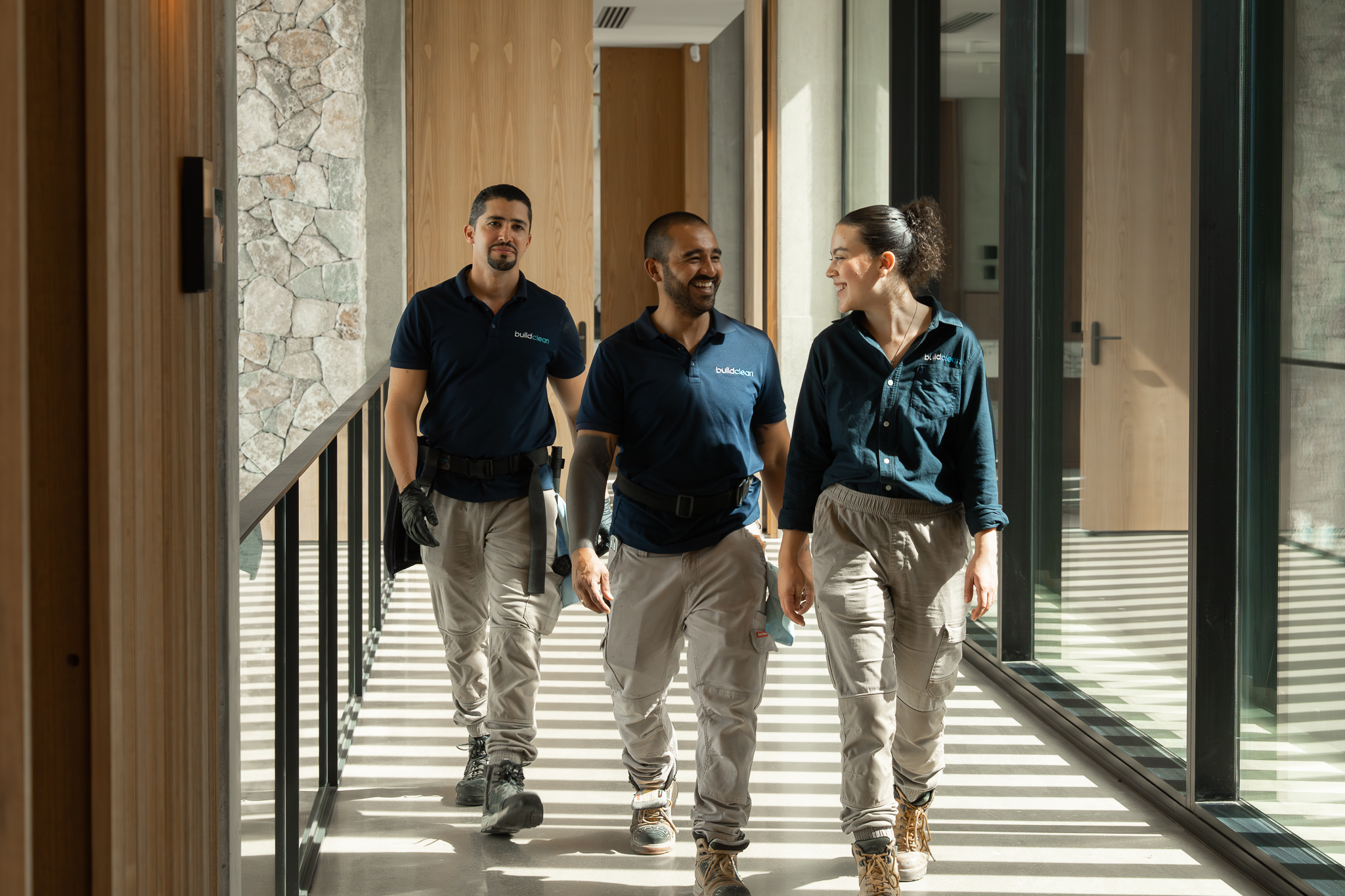
TLDR: Subcontracted builders cleaners come with three serious risks: inconsistent training and quality, gaps in insurance and certifications, and broken accountability when something goes wrong. Directly employed cleaning teams deliver consistent quality, full insurance coverage, and one chain of accountability. Build Clean directly employs 150+ cleaners across SA, VIC, NSW, and QLD. There are no subcontractors on Build Clean sites.
The subcontractor problem in builders cleaning
A lot of builders cleaning quotes are sold by one company and delivered by another. The customer talks to a sales person, signs a contract with a company name, and at handover a different team turns up with no idea who hired them.
This is the subcontractor model and it dominates the cheap end of the Australian builders cleaning market. The contractor on the quote outsources the work to individual subcontractors who are paid a flat rate to “do the job”. The contractor takes a margin. The subcontractor takes whatever’s left after their costs.
The model survives because it’s profitable for the contractor. It fails because of three structural risks the builder ends up wearing.
 Risk 1: Inconsistent training and quality
 Risk 1: Inconsistent training and quality
Every subcontractor brings their own training, their own tools, their own products, and their own standard. The contractor on the quote has no real control over how the job is done.
What this looks like in practice:
The builder gets whatever the subcontractor happens to bring. Quality is unpredictable.
Compare to directly employed crews: same training, same products, same equipment, same sequence on every job. Quality is consistent.
Risk 2: Insurance and certification gaps
Subcontractors typically carry their own insurance and their own certifications. The contractor on the quote often doesn’t verify either.
Common gaps:
- Inadequate public liability. Many individual subcontractors carry only minimum coverage. The contractor on the quote may claim $10 to $20 million PL, but that’s only the contractor’s policy. Damage caused by a subcontractor’s work may fall under the subcontractor’s policy, not the contractor’s.
- No workers compensation. Sole-trader subcontractors often don’t carry workers comp on themselves. If they’re injured on site, the builder can be liable.
- Expired or missing certifications. White Card, EWP, Working at Heights tickets expire. Subcontractors who haven’t kept them current present a legal exposure for the builder.
- No police clearance. Few subcontractors carry police clearance.
When a builder asks the contractor for the insurance certificate, the contractor sends their own. The subcontractor’s certificates are rarely provided unless requested specifically.
Compare to directly employed teams: every operator covered under the company’s PL and workers comp. Certifications verified and tracked. Police clearance standard.
Risk 3: Broken accountability
When something goes wrong with a subcontracted clean, accountability breaks down.
The client complains to the builder. The builder complains to the contractor. The contractor blames the subcontractor. The subcontractor disappears or refuses to return. The builder is stuck.
This pattern is well documented in the Australian construction industry. It’s particularly common when:
With directly employed crews, accountability is clear. The same company that quoted the job is the company that did the work. The same supervisor who signed off the clean is the supervisor responsible for any rectification.
What does “directly employed” actually mean?
Directly employed means every operator on every job is on the company payroll. They are W-4 employees (or the Australian equivalent), not 1099 contractors. The company:
- Withholds tax
- Pays superannuation
- Covers workers compensation
- Provides ongoing training
- Issues PPE and equipment
- Manages performance and quality
Not directly employed means the operator is an individual contractor who invoices the company. The relationship is transactional. The company has no employment obligations.
The distinction matters because it changes the company’s incentives. A company with 150 employees on payroll has every reason to invest in their training, retain them long-term, and ensure quality. A company that rotates subcontractors has no such incentive.
How to check if a contractor uses subcontractors
Five questions to ask before signing:
Why does Build Clean directly employ?

Three reasons.
Quality. Consistent training, consistent quality, consistent results. Every Build Clean operator follows the same methods, uses the same products, and works to the same sequence.
Accountability. One company. One chain of accountability. When the builder calls Build Clean about an issue, Build Clean owns it.
Reputation. Build Clean’s reputation lives or dies with every job. Subcontracting that work to someone else is subcontracting the reputation.
What does this cost the builder?
The directly employed model is more expensive than the subcontracted model. Build Clean is not the cheapest quote on most jobs.
The difference: roughly $300 to $800 on a 250m² residential handover versus a cheap subcontracted quote.
What the builder gets for that: $20 million in public liability, every operator certified and police-cleared, consistent training and quality, one chain of accountability, and a documented defect walk-through.
What the builder avoids: the cost of damage from untrained operators, the legal exposure of uncertified crews, the program risk of subcontractor no-shows, and the reputation damage of a failed handover.
Frequently asked questions
Do you ever use subcontractors? No. There are no subcontractors on Build Clean sites. Every operator is a direct Build Clean employee.
What’s your operator headcount? 150+ directly employed cleaners across SA, VIC, NSW, and QLD as of 2026.
How do you scale for large commercial projects? By scheduling crews from across the directly employed team. Build Clean has scaled crews up to 30+ operators for large school, defence, and multi-residential handovers without using subcontractors.
Can I see your workers compensation policy? Yes. Build Clean provides the certificate of currency on request.
What happens when an operator is sick or away? Build Clean covers absences with other directly employed operators. No subcontractor backfill.
Are subcontractors ever legitimate? For some industries yes. For premium builders cleaning where finish-specific training, certification consistency, and accountability matter, the directly employed model is the right structure.